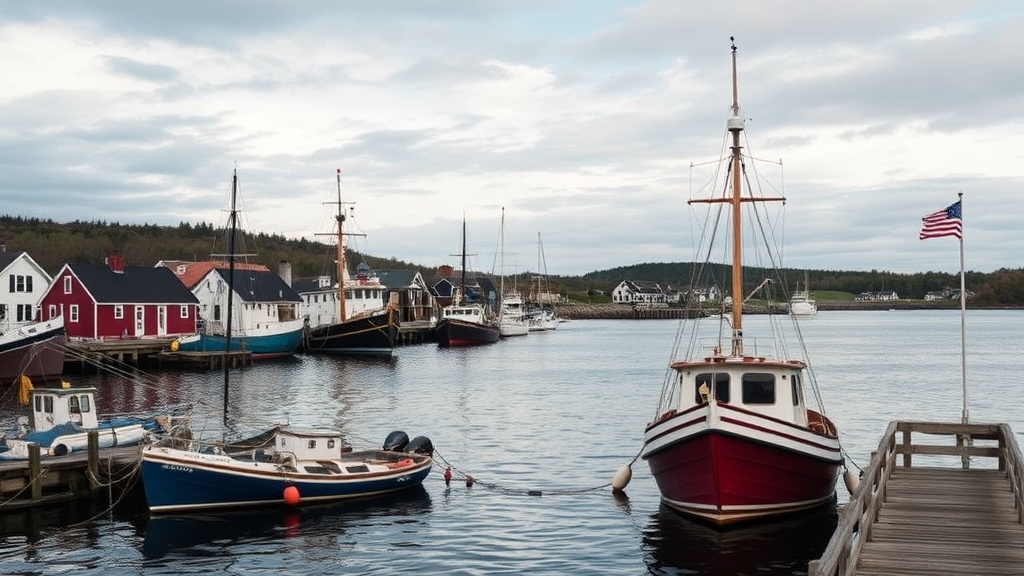
5 Bay of Fundy Communities Where Maritime Traditions Still Thrive

St. Andrews by-the-Sea: Historic Charm Meets Working Waterfront
Alma: The Fishing Village Gateway to Fundy National Park
Hall's Harbour: Where Tides Shape Daily Community Life
Parrsboro: Fossil Heritage and Local Artistry Combined
St. Martins: Sea Caves and Community Resilience
Across the Bay of Fundy region, maritime traditions aren't museum pieces — they're living practices woven into daily life. This post explores five communities where boat-building, dory fishing, lighthouse keeping, and coastal craftsmanship remain active parts of our shared heritage. Whether you're tracing family roots or simply curious about how our coastal ancestors worked these waters, these places offer an authentic glimpse into traditions that refuse to fade.
Which Bay of Fundy Community Has the Oldest Continuous Boat-Building Heritage?
Halls Harbour, Nova Scotia, along the Bay of Fundy shore, has maintained active boat-building operations since the early 1800s — making it one of the oldest continuous maritime craft centers in Atlantic Canada. The harbour itself tells the story: weathered fishing sheds cling to the rocky coastline, and the scent of cedar shavings still drifts from working boatyards on weekday mornings.
The Halls Harbour Boatyard represents the heart of this tradition. Operating continuously since 1830, the yard has built everything from small dories to sturdy fishing vessels designed specifically for Bay of Fundy's notorious tides. Local craftspeople here still use traditional methods — hand-laid planks, steam-bent ribs, and copper roves — techniques passed down through generations of shipwright families.
What makes Halls Harbour remarkable isn't nostalgia — it's practicality. Fishermen still need boats that can handle the world's highest tides (yes, the Bay of Fundy holds that record at 16 meters). Modern fiberglass hulls crack against these granite shores; the wooden boats built here flex, absorb impact, and get repaired by the same hands that shaped them. The community gathers each August for the Halls Harbour Boat Festival, where you'll see demonstrations of caulking, oar-making, and traditional net-mending.
The Wharf Road area features several family-owned businesses where you can watch boats under construction. Danny's Boat Shop — run by the third generation of the Himmelman family — specializes in traditional Fundy dories, the flat-bottomed workhorses that defined our fishing industry for two centuries. These aren't display pieces. Local fishermen still use them for lobstering, cod fishing, and scalloping.
Where Can You Experience Traditional Dory Fishing in the Bay of Fundy?
Grand Manan Island, sitting at the mouth of the Bay of Fundy, maintains the most authentic dory fishing tradition remaining in Atlantic Canada. Here, the Grand Manan Fishermen's Association continues practices that date back to the 1700s — small boats launched from beaches, handlining for cod, herring, and lobster using methods unchanged for generations.
The island's geography demands this approach. With no natural harbours deep enough for large trawlers, Grand Manan's fishermen adapted to their environment. They developed the Fundy dory — a remarkably stable, shallow-draft boat that can be hauled up on rocky beaches between tides. These boats are light enough for two people to carry, sturdy enough to handle swells that would swamp lesser craft, and simple enough to repair with hand tools.
Head to North Head or Seal Cove at dawn during fishing season. You'll see the routine: boats pulled above the high-tide line, fishermen carrying gear down narrow paths, the quiet coordination of launching into surf. The Grand Manan Museum maintains an extensive collection of dory-building tools and fishing equipment, but the real education happens on the water — or rather, at the water's edge, where the community still depends on these traditional methods.
Several island families offer informal apprenticeships for young people interested in learning the trade. The Swan Island weir fishery — visible from Grand Manan's western shore — represents another living tradition. These fixed fishing traps, constructed from wooden stakes and netting, have operated continuously since the 1830s. The Grand Manan tourism website provides seasonal information about when visitors can observe weir operations, though access is limited to respect working fishermen.
What Makes St. Martins the Best Place to See Traditional Bay of Fundy Lighthouse Keeping?
St. Martins, New Brunswick, offers the most comprehensive look at traditional lighthouse keeping culture anywhere along the Bay of Fundy. While automation replaced keepers at most stations by the 1990s, this community preserved both the physical structures and the human knowledge that kept them operating through storms, wars, and technological changes.
The St. Martins Sea Caves and Lighthouse area serves as the focal point. The current lighthouse (rebuilt after the original 1863 structure was damaged) includes a small museum staffed by descendants of actual keepers. Here's the thing — these aren't generic maritime exhibits. The displays include logbooks from Quaco Head Lighthouse, showing daily entries about weather conditions, ship sightings, and maintenance tasks performed in conditions that would send most people indoors.
The Fundy Trail Parkway provides access to several historic light stations, including the Long Eddy Point Lighthouse on Deer Island. This particular station operated continuously from 1874 until 1993, with three generations of the same family maintaining the light. The original Fresnel lens — a marvel of 19th-century engineering — remains on display, and local volunteers conduct demonstrations showing how keepers polished the glass prisms, trimmed wicks, and maintained the intricate clockwork mechanisms that rotated the beam.
Community members in St. Martins actively preserve the keeper lifestyle beyond the buildings. The St. Martins Peninsula Heritage Group hosts monthly gatherings where former keepers and their families share stories, demonstrate maintenance techniques, and maintain the practical skills required to operate these stations. You'll learn about the daily rhythm: polishing brass, painting the tower (red and white bands require constant upkeep), maintaining the foghorn machinery, and recording every ship passing within sight.
| Community | Primary Maritime Tradition | Best Time to Observe | Key Location |
|---|---|---|---|
| Halls Harbour, NS | Traditional boat-building | August (Boat Festival) | Halls Harbour Boatyard |
| Grand Manan Island, NB | Dory fishing & weir operations | May-October (fishing season) | North Head & Seal Cove |
| St. Martins, NB | Lighthouse keeping heritage | Year-round | Long Eddy Point Lighthouse |
| Parrsboro, NS | Ship salvage & maritime crafts | July-August | Ship's Company Theatre area |
| Digby, NS | Scallop fishing traditions | Year-round (peak in fall) | Digby Wharf & working waterfront |
Why Does Parrsboro Preserve Bay of Fundy Ship Salvage Traditions?
Parrsboro, Nova Scotia, on the Bay of Fundy's Minas Basin shore, maintains North America's most active community of ship salvage experts and maritime craftspeople. This isn't treasure hunting — it's the practical tradition of recovering materials, understanding construction techniques, and preserving the stories of vessels lost to Fundy's unforgiving tides.
The Ship's Company Theatre complex sits at the center of this activity. Built from the salvaged remains of several historic vessels, the theatre itself demonstrates the community's philosophy: nothing useful goes to waste, and every piece of maritime material carries history worth preserving. Local craftspeople here specialize in trunnel-making — the wooden pegs that traditionally fastened ship planks before metal fasteners became common. This skill, nearly extinct elsewhere, remains active in Parrsboro because the community actively uses traditional methods for building and maintaining boats.
The Parrsboro Shore Historical Society maintains extensive records of shipwrecks along this stretch of coast — over 300 documented losses dating back to 1750. Community members can trace many of these wrecks to specific families, specific weather events, specific economic circumstances. The salvage tradition here includes ethical protocols developed over generations: respect for the dead, fair division of recovered materials among community members, and preservation of items with historical significance.
Visit the Ottawa House Museum to see the results of this tradition. The collection includes ship's bells, figureheads, navigational instruments, and personal items recovered from Bay of Fundy wrecks. More importantly, the museum maintains oral history recordings from community members who participated in salvage operations from the 1930s through the 1970s — the last generation to make their living partly through this traditional practice. Tourism Nova Scotia lists Parrsboro as a key heritage destination, though the salvage community remains focused on local preservation rather than tourism.
How Has Digby Kept Traditional Scallop Fishing Alive in the Bay of Fundy?
Digby, Nova Scotia — famously the "Scallop Capital of the World" — represents the largest remaining community in the Bay of Fundy where traditional scallop fishing methods still operate alongside modern techniques. The Digby wharf area remains a working waterfront where you can observe practices that haven't fundamentally changed since the 1920s.
The Digby Scallop Fleet includes vessels that still use traditional dredge gear — heavy iron frames dragged across the sea floor, connected to the boat by thick wire cable. The technique requires intimate knowledge of Bay of Fundy bottom conditions, seasonal migration patterns, and tidal currents. Local captains pass this knowledge down through families, with many current operators being fourth or fifth generation.
What distinguishes Digby is the community infrastructure supporting these traditions. The Digby Scallop Days Festival (held each August) celebrates not just the catch but the entire cultural complex: the boat-building techniques specific to scallop vessels, the shucking methods developed to process scallops quickly at sea, the traditional recipes for preparing the iconic "Digby chicken" (dried scallops), and the social structures that supported fishing families through dangerous work.
The catch? Maintaining these traditions requires active participation. The Digby Fishermen's Association operates training programs where young people learn vessel maintenance, navigation without modern GPS (still taught as backup), and the mechanical skills to keep diesel engines running far from port. Fisheries and Oceans Canada works with the association to ensure conservation measures respect both ecological needs and traditional fishing rights.
Walk along Water Street in the early morning during fishing season. You'll see the full operation: vessels returning with holds full of scallops, workers unloading and grading the catch, the small processing plants that still use traditional shucking techniques (hand-held knife, specific grip, practiced speed). The Digby Whaleback — a distinctive local boat design with a rounded bow — remains the preferred vessel type for working these waters. You won't find these boats anywhere else; they evolved specifically for Bay of Fundy conditions.
Each of these communities demonstrates that maritime traditions survive not through preservation societies or museum exhibits — though those help — but through continued practical use. The boat-builders of Halls Harbour build boats because fishermen need them. The dory fishers of Grand Manan use traditional methods because they work better than alternatives for their specific geography. The lighthouse knowledge of St. Martins, the salvage ethics of Parrsboro, the scallop techniques of Digby — all persist because they solve real problems for real people living along these shores. Worth noting: the Bay of Fundy doesn't make living here easy. The tides, the weather, the rocky coast — all demand respect and accumulated knowledge. These communities have kept that knowledge alive.